


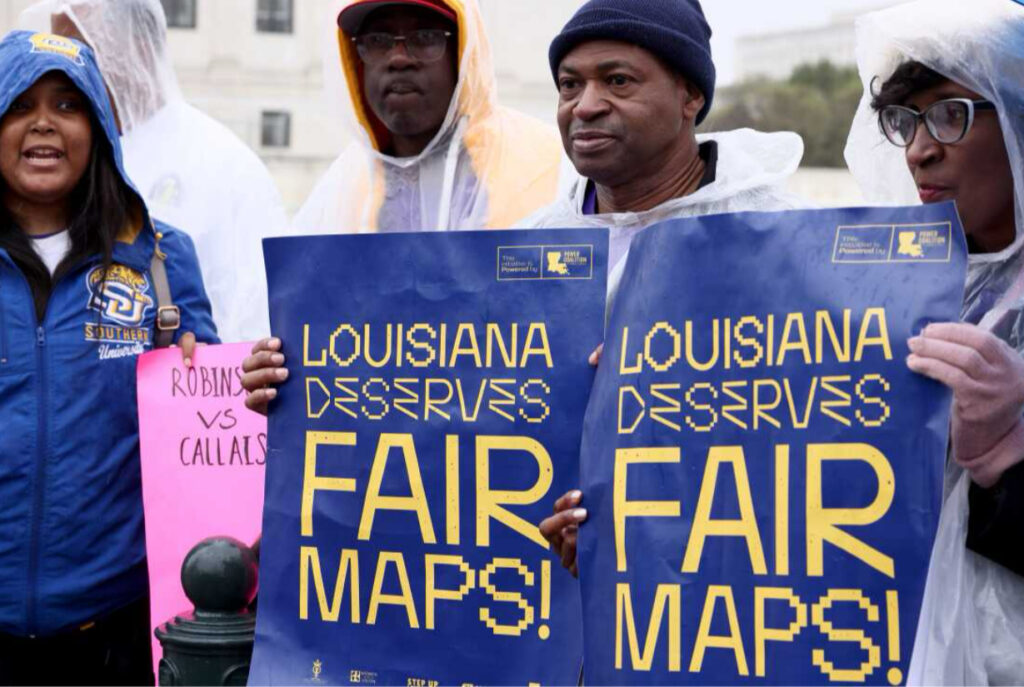
Jemal Countess/Getty Images
The recent Supreme Court case, Louisiana v. Callais, marks a critical examination of Section 2 of the Voting Rights Act of 1965, which serves as a protective measure against racially discriminatory voting practices. This case assumes particular significance against the backdrop of increasing national political polarization, particularly concerning the voting rights of Black and brown communities, and the configurations of their congressional districts.
Political science professor Richard Johnson from Oklahoma University emphasizes the foundational role of the Voting Rights Act in American democracy, stating, “You can’t put the United States and democracy in the same sentence until the Voting Rights Act happens.” This profound statement underscores the Act’s historical importance in safeguarding the voting rights of marginalized communities.
Initially passed during the Lyndon B. Johnson administration, the Voting Rights Act prohibits voting practices that exhibit racial discrimination. Under Section 2, redistricting initiatives must correspond with demographic realities, ensuring that underrepresented communities have an equal voice in governmental elections. This section is a permanent feature of the Act and is applicable nationwide, provided its triggering conditions are met.
In Louisiana v. Callais, the plaintiffs argue that mandates for majority-Black districts lead to unconstitutional and racially biased redistricting. Should the Supreme Court’s Republican majority side with this argument, it may facilitate the redrawing of at least 19 congressional districts across Southern states, a move that has profound implications for Black and Latino representation in Congress, potentially diminishing it by nearly a third.
Concern is palpable among young activists like Shelby Bennette, a senior psychology major at Howard University and native of New Orleans, who articulates a powerful observation: “If this redistricting happens, District 6 will now include District 2. It’s insane… we are looking at representation for Black Louisianians on a federal scale.” This potential shift highlights the stakes of congressional representation for marginalized communities.
This case arises a decade after the landmark ruling in Shelby County v. Holder, which notably weakened the Voting Rights Act by enabling stringent voter ID laws and restricting early voting, measures that adversely affected Black voter turnout. Legal experts caution that another rollback of Section 2 could lead to even broader ramifications, further obstructing the political power of communities of color.
Amidst this legal turmoil, there is a concerted effort by the Republican Party to solidify a national majority, as historical voting patterns show that Black Americans overwhelmingly align with the Democratic Party—83% according to a 2024 Pew Research study. With only 19.3% of the Southern population identifying as Black, the stakes of this case are even greater.
Section 2 is designed to correct the systemic inequalities within the electoral process by ensuring that redistricting reflects the demographics of racial minorities, thereby affording these communities the ability to elect representatives that accurately reflect their interests. The dismantling of this protective measure could simplify the process for maintaining a Republican majority, contradicting the equality that Section 2 was intended to achieve, as highlighted by NPR.
If Section 2 is annulled, the voting power of the 19.3% of Black residents in the South would risk being subsumed into predominantly white districts, effectively diluting their electoral influence. This dilution signifies that every Black vote may hold substantially less weight and impact, amplifying concerns that such changes could lead to a re-segregation of various political bodies—including legislatures, city councils, and school boards—as reported by CNN.
Johnson points out that reducing the focus on race in voting issues would be misleading, stating, “It’s very important that communities of color have the numerical representation… especially Black voters.” This indication of urgency reflects the delicate balance of representation within the political sphere.
Throughout this discourse, the historical significance of institutions like Howard University—home to alumni such as Supreme Court Justice Thurgood Marshall, who have left indelible marks on civil rights—evokes a sense of responsibility among current students. Bennette stresses the importance of civic engagement amid political turmoil, stating, “It shows how fragile democracy is… If [Section 2 is] overturned, it needs to be a wake-up call; you need to go out there and show up ten times more.”
The implications for Washington, D.C., a city where 43% of residents are Black, further amplify the importance of this case. The potential rollback of Section 2 would inevitably influence district drawing processes, impacting political representation throughout the Capital.
As voices from various communities advocate for their rights, the erosion of electoral power among Black and brown constituents may have far-reaching effects, fostering deeper divisions and diminishing trust in the democratic process. Bennette emphasizes the crucial role of advocacy, noting the legacy of Howard University and the responsibility alumni bear in shaping political discourse.
“As Howard students, especially Howard students from Louisiana, we have to use our platforms. You need to advocate for yourself and your community—no one’s going to save you. You have to save yourself,” she articulates, embodying the spirit of activism needed in these trying times.
Copy edited by Damenica Ellis


