When students and young professionals think about studying abroad, the allure often lies in travel, fun, and cultural immersion. Yet, history has shown that studying abroad can be a transformative journey, essential for personal and professional growth. Many prominent African Americans utilized international education and global exposure as steppingstones toward success, leadership, and impactful careers.
Here are a few inspiring examples that demonstrate the transformative power of studying abroad.
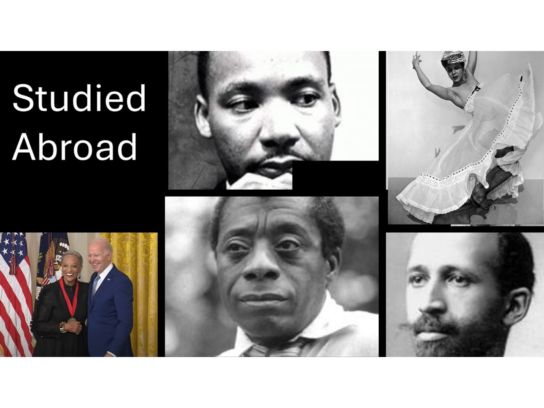
- Dr. Martin Luther King Jr. – Expanding a Global Vision
Best known for his leadership in the American Civil Rights Movement, Dr. King’s journey also included significant international experiences. In 1959, he traveled to India to study Mahatma Gandhi’s philosophy of nonviolent resistance. This immersive experience enabled him to learn beyond classroom walls, making it akin to a modern study-abroad program.
How International Study Shaped Dr. King’s Road to Success:
King’s time in India deepened his commitment to nonviolence and broadened his perspective on global struggles for freedom and justice. This international exposure underscored the connection between civil rights in America and human rights worldwide, ultimately shaping his legacy as a global leader.
- W.E.B. Du Bois – Scholar, Activist, Global Thinker
Before becoming one of the most significant intellectuals and civil rights leaders in American history, W.E.B. Du Bois studied at the University of Berlin in Germany. His studies abroad enriched his understanding of social science, providing insight into race, class, and progressive political thought.
How Studying Abroad Shaped Du Bois’ Road to Success:
Du Bois attributed his international education to sharpening his analytical skills and gaining a broader perspective on global inequalities. These experiences profoundly influenced his acclaimed work, The Souls of Black Folk, and his leadership role in the NAACP.
- James Baldwin – Writer Without Borders
The legendary author and activist James Baldwin relocated to Paris, France, in his early 20s. Although he wasn’t enrolled in a formal academic program, Baldwin immersed himself in European intellectual and artistic circles, paralleling contemporary study-abroad experiences.
How Baldwin’s International Experiences Shaped His Success:
Living abroad provided Baldwin with the distance necessary to write candidly about race, identity, and American society. Many of his most influential works were composed during his time overseas, highlighting how global exposure can unlock creative expression and clarity.
- Katherine Dunham – Dancer, Anthropologist, World Traveler
Katherine Dunham was a pioneering dancer and choreographer who studied dance and anthropology in the Caribbean, particularly in Haiti and Jamaica. Her international studies deeply enriched her artistic expression and academic research.
How Studying Abroad Shaped Dunham’s Road to Success:
By immersing herself in various cultures, Dunham developed a unique dance technique that merged African and Caribbean influences. Her global education facilitated an international career and broke racial barriers in the arts.
- Johnnetta Betsch Cole, Ph.D. – Educator and Global Leader
As an anthropologist, educator, and the first African American woman president of Spelman College, Dr. Cole engaged in studies and research abroad, including work in Liberia and other parts of Africa and the Caribbean.
How Studying Abroad Shaped Cole’s Road to Success:
Her global experiences informed her leadership style and commitment to cross-cultural understanding. Dr. Cole’s influence extends to higher education, public policy, and international discourse. Recently, she continued her legacy by serving as the National Chair and seventh President of the National Council of Negro Women (NCNW), advocating for humanity and empowering Black women.
Why This Matters…
These trailblazers exemplify that studying abroad is not merely a luxury; it’s a profound tool for growth. For students, recent graduates, and young professionals, international experience can:
- Expand career opportunities
- Build global networks
- Strengthen leadership and confidence
- Inspire creativity and a sense of purpose
Your passport could be your gateway to a lasting legacy.
Travel Talk Study Abroad Tips…
Studying abroad doesn’t always require a full semester in a foreign country. Here are various options that can fit your goals and budget:
- Short-term faculty-led programs (2–6 weeks)
- Summer research or internship opportunities abroad
- Service-learning experiences
- Work-abroad or fellowship programs
- Cultural immersion trips connected to your major
Before applying, consider three key questions:
- How does this experience align with my career goals?
- What skills can I gain to enhance my résumé?
- Who can I meet that could help expand my global network?
Final Thoughts…
At Travel Talk with Sheila and Friends, we believe that the world is a vast classroom. The journeys of these iconic African Americans serve as a reminder that stepping outside one’s comfort zone can lead to remarkable opportunities. If you’re considering studying or working abroad, take that leap!
Subscribe to the Travel Talk with Sheila and Friends Podcast YouTube Channel for more episodes as they are released! https://www.youtube.com/@sgotraveltalk/videos